Navigaton: Overview | Talking points | Submit your statement
What’s Going On
The operators of Yallourn and Hazelwood coal mines have released their official Declared Mine Rehabilitation Plans (DMRPs) for community feedback. These plans show how they plan on rehabilitating the land when mining ceases, including details on their proposals for filling the mines with water from the Morwell River and the critically flow stressed Latrobe system.
The operators are required to consult with the community as part of the regulatory process, which is where you come in.
Why This Matters
Mine rehabilitation will impact the Latrobe Valley and greater Gippsland for generations. These plans affect regional water security, land stability, our environmental , and how the land can be used again in the future. Strong public submissions can help push for better outcomes for community, Country and future climate resilience .
How does this fit with the other decisions being made about mine rehabilitation?
Rehabilitating the Latrobe Valley’s three huge coal mines is an enormous task, and one that will have long lasting ramifications for future generations. Due to the implications for water, community and the broader environment, there are three key processes that together determine final rehabilitation plans.
| Application for Bulk Water Entitlements
All operators currently plan to fill their mines with river water, to do this they must have a bulk entitlement. Applications for Loy Yang and Yallourn will decided by Victoria’s Minister For Water. |
Declared Mine Rehabilitation Plans
Operators share their detailed rehabilitation plans with community for feedback (this process) and submit their final plan to the government by October 2025 |
Victoria’s Environment Effects Statement (EES) and Federal Environment Protection and Biodiversity Conservation (EPBC) | |
| Hazelwood Mine, owned by Engie, closed in 2017.
It will take 637GL of water to fill Hazelwood mine, that’s more water than Sydney Harbor. |
Engie do not need to apply for a bulk water entitlement through this process, as they already have an agreement with Gippsland Water to take water from the Latrobe River. | Engie are accepting community feedback on their rehabilitation plan until August 30. (See our guide for having your say, below) | Thanks to community advocacy, Hazelwood’s rehabilitation plans are subject to scrutiny from the Victorian and Commonwealth Governments through the EES process. The next big step in the process will be a government-run consultation next year – with opportunities to examine in detail the environmental impacts (and mitigation strategies) of their plans. |
| Yallourn mines, owned by Energy Australia is scheduled to close in 2028.
Like Hazelwood it will take more water than Sydney Harbour holds to fill the mine, 630GL |
Energy Australia have not yet made an application for water, but they will need to if they are seeking river water to fill the mine. | Energy Australia are accepting community feedback on their rehabilitation plan until August 30. (See our guide for having your say, below) | An EES has not yet been announced for Yallourn, but considering the scale of the project we’d expect Energy Australia to refer the project for review. |
| Loy Yang owned by AGL Australia is expected to close in 2035.
It will take 1,087GL, more than double the water in Sydney Harbour to fill Loy Yang Mine. |
AGL has applied for a water entitlement, and as a result of community feedback on their application the Minister for Water is now asking for community input on how much companies should pay for the water they use. (You can still have your say on this before 30 August!) | AGL have not consulted on their rehabilitation plan yet, but we expect they will in the coming months. | An EES has not yet been announced for Loy Yang, but considering the scale of the project we’d expect Energy Australia to refer the project for review. |
Key Talking Points
You don’t need technical expertise to offer your feedback on these plans. Speak from the heart and from your own lived experience. Here are some things you might include:
Personal Points:
- Share your connection to the Latrobe Valley, the Latrobe River and the Gippsland Lakes.
- Express your hope that rehabilitation will be done fairly, safely, and in ways that allow future generations to use and enjoy the land and waterways.
- Emphasise the importance of protecting our environment, water security, local tourism and agricultural economies and community wellbeing.
- Outline your personal response to the plans, what would you like to see happen?
More Technical Points (optional):
-
- For both mines, ask where the water will come from to fill the mine pits, especially when local rivers are already being pushed to the brink by over extraction of water. You could ask them to consider using recycled water, so the water to fill the mine pits is not coming out of our rivers.
READ MORE (click to expand notes below)
- The Latrobe River is already under immense pressure - The river system has been degraded by a century of coal mining, pollution and over extraction of the water it needs to function as a healthy living waterway. Taking more water — even from “high flow” periods — will cause further damage unless carefully regulated. Long-term climate trends point to less water availability, meaning we must prioritise resilience of the rivers and lakes which support us.
- Using alternative sources of water - Alternative water sources – such as recycled water piped from the Eastern Treatment Plant and desalinated water - for rehabilitation have previously beenruled out as being financially unfeasable. But the analysis that led to this decision relied on river water being priced upon what coal mining companies have historically paid, which is almost nothing. These alternate water options were dismissed on cost grounds — but the comparison priced river water at an absurdly low $11.55 per megalitre. (A new independent report recommends raising the price to $250-$300 per megalitre)This artifically low price has skewed the assessment at the cost of our rivers.
-
- For Yallourn mine, we’re concerned about the risk of the Morwell River Diversion failing again and being permantantly collapsed into a pit lake, and what that will mean once those flows, nutrients and aquatic life can no longer make their way through to the river and Gippskand Lakes.
READ MORE (click to expand notes below)
- The Morwell River Diversion (MRD) is a levee which runs through the Yallourn Mine, running between two giant coal pits on Energy Australia Yallourn mine land. It has collapsed before and local community and experts expect that it WILL fail again. Another failure would likely mean a significant loss of water and, due to contamination, risks to other water users and the health of the Latrobe River.
- The MRD was designed so that fish and sediment nutrients could still flow from high in the Strzelecki’s through to the Latrobe River and downstream, feeding the life in the lower wetlands and beyond. However since the repair works to the MRD in 2021, the structure can no longer support high flows floods, which are essential for river resilience and flushing of the Latrobe River through to the Gippsland Lakes. High flows are now diverted into the mined-out Township field of the Yallourn mine, with Energy Australia planning for an engineered spillway to divert water via a coal pit before it enters the Latrobe River when they begin the full pit rehabilitation
The Morwell River Diversion Collapse IssueThe Morwell River Diversion (MRD) was constructed to redirect the Morwell River around the Yallourn coal mine during active mining operations. It now runs between two giant coal pits on Energy Australia Yallourn mine land. Energy Australia Yallourn has acknowledged in their rehabilitation planning documents that this diversion infrastructure faces significant collapse risks as the mine pit is filled with water. The company has stated it cannot guarantee the long-term structural integrity of the MRD and plans to replace it with a substantially smaller levee system designed only to carry minimal environmental flows, with flood waters being redirected through spillways into adjacent fields.
The primary concern is the permanent loss of Morwell River flows to the broader Latrobe River system. Under the proposed rehabilitation plan, this ‘flood-skimming’ would divert a majority of the Morwell River's water to be captured within the mine pit rather than continuing its natural flow path to the Latrobe River and Gippsland Lakes. This represents a fundamental alteration to the catchment's hydrology, eliminating the variable seasonal flows and flood events that are essential for maintaining downstream ecosystem health, supporting aquatic biodiversity, and preserving the ecological values of the internationally significant Ramsar-listed wetlands in the Gippsland Lakes system.
The implications extend beyond immediate environmental impacts to include potential breaches of environmental legislation and existing water allocation frameworks. Climate change projections indicate that water yields across the Latrobe catchment may decrease by up to 30%, making the retention of natural river flows increasingly critical.
Current government risk assessments have not adequately considered these long-term hydrological changes, therefore approving mine rehabilitation plans without guaranteeing continued river connectivity could compromise existing water entitlements and environmental obligations under both state and Commonwealth legislation.
For Hazelwood, highlight concerns about the HARA ash dump which is situated inside the mine, and the long-term risk of toxic materials leaching into the environment.
READ MORE (click to expand notes below)
- Coal ash contains concentrated levels of the toxic chemicals and heavy metals found in coal, these include lead, mercury and arsenic. The contaminants in coal ash can travel in surface water and groundwater and in the air as dust. We know that there are contamination issues at the HARA ash dump, as it isn’t lined properly and is already leaching contamination into the groundwater underneath it.
- In 2023, our friends at Environmental Justice Australia commissioned an independent coal ash expert to examine Engie’s plans to flood the mine without removing the coal ash waste stored within the mine pit.
- The report found that flooding the mine pit without the coal ash dump being removed would likely result in floating coal ash visible as a white film of ash on the rising pit lake. The ash would likely leach toxinswhich could become mobile in the lake. The report suggested that that coal ash should be removed from the coal mine prior to any flooding.
- The report also found that installing a ‘cap’ on the coal ash dump would be ineffective if the mine is filled with water. And that with or without a ‘cap’, chemical leaching when the Hazelwood mine pit becomes flooded with water is inevitable.
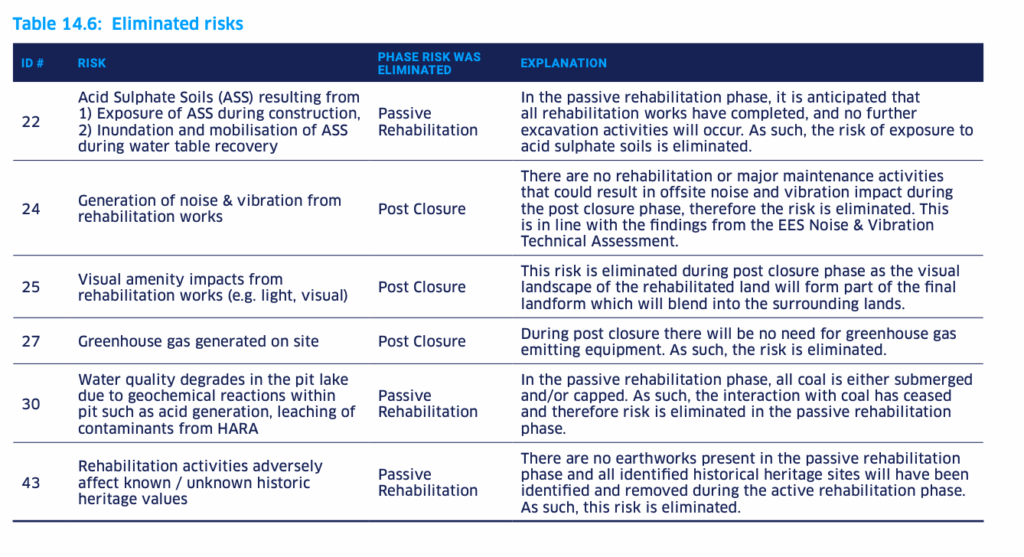
- This is in contrast to Engie’s assessment of this risk in their Declared Mine Rehabilitation Plan. Their Risk Assessment and Management document (available to download from this page) lists the risk of water contamination from the Hazelwood Ash Retention Area (HARA) alongside the risk of contamination from the exposed coal, and considers this risk ‘eliminated’ but the explanation for why it’s no longer considered a risk relies on ‘capping’ which independent experts have advised is not sufficient. We’d like to see them remove the coal ash waste so that its toxins will not leach into the Lake water. If they don’t do that, the risk should not be considered ‘eliminated,’ and ongoing water monitoring and contingency planning should be established.
Recommendations
Click to see a range of recommendations you can include in your submission
Infrastructure Resilience
Call for robust engineering solutions to ensure long-term structural integrity of river diversions and water management infrastructure and designs that prioritise durability over short-term cost savings.
Environmental Flow Protection
Demand critical environmental flows are returned to the Latrobe system before any water diversion or ‘flood-skimming’ for mine rehabilitation. Oppose excessive flood capture systems and call for enforceable limits and costs applied to any water losses to natural waterways.
Transparent Governance
Push for clear resolution of infrastructure ownership and responsibility between government and private operators before major water allocation decisions. Advocate for decisive management of water resources to address existing shortfalls.
Regulatory Oversight
Challenge inadequate water entitlement conditions that fail to account for infrastructure risks. Highlight obligations under environmental protection legislation and international agreements for management of RAMSAR listed Gippsland Lakes and wetland conservation.
Precautionary Approach
Advocate for protecting natural water flow patterns rather than accepting unproven engineering solutions that may compromise long-term environmental and community water security.
How to Have Your Say:
Yallourn (EnergyAustralia)
Read the full DMRP plan here>>
Or check the summary version here>>
Submit your views:
- Or email the Energy Australia team directly: community.yallourn@energyaustralia.com.au
Hazelwood (ENGIE)
Or review the summary version>>
Submit your views:
- Or email your thoughts directly to: hazelwood.au@engie.com