Blog | 20th Jul, 2026

Higher prices and more pollution: the Victorian Liberals' gas policy explained

At best it’s an ineffective policy, at worst it could be the first part of a plan to shield decisions from public scrutiny and bring highly destructive gas fracking to Victoria.

Liberal leader Jess Wilson has announced that, if elected, the Liberal National Party would “throw open the door” to new onshore gas exploration. It sounds simple enough, but once you start digging the problems start multiplying.

At best it’s an ineffective policy, at worst it could be the first part of a plan to shield decisions from public scrutiny and bring highly destructive gas fracking to Victoria.

So read on to find out what’s hidden beneath the surface (spoiler alert – there’s no gas there) …

In this article:

💸 Why new gas exploration relies on high gas prices 💸

Jess Wilson talked up the potential of onshore gas in her announcement — but the only way new drilling will happen is if gas prices go even higher than they are now.

Onshore and near-shore gas exploration has occurred in Victoria for 100 years and there is nothing stopping it continuing today, other than a lack of economically viable gas.

The only onshore gas prospect on the table today, Lakes Blue Energy’s Wombat gas field, is a contingent resource which means it is not commercially viable unless gas prices are high. Lakes Blue Energy is now banking on energy-hungry data centres to create demand and push prices up.

It’s a similar situation for offshore gas. What gas is left in Bass Strait is expensive to extract and would cost far more than manufacturers want.

The gas executives themselves could not have said it more clearly – cheap gas, subsidised by oil production in years past, no longer exists.

This policy is all about giving the gas industry what it wants so they can make even larger profits. It would do nothing to drive down the energy bills of ordinary Victorians.

🔎 The gas just isn’t there 👀

Since oil and gas were discovered in Bass Strait in the 1960s, Victorians have been consuming gas like it is going out of fashion. Now those supplies are running dry and there is no way to conjure more gas. Unlike renewable energy, once it’s gone, it’s gone.

Even if new exploration goes ahead, as Jess Wilson is proposing, there is no guarantee they will find anything.

Gas company drilling campaigns are now facing up to this reality. In January this year, Amplitude Energy’s prospective Elanora-1 gas field off the Otway coast found water instead of gas. Only two weeks prior they had reported a  67% chance of success.

Recently, at the behest of the gas industry, the Victorian Labor government invited applications to explore for gas near the Bay of Islands Coastal Park between Warrnambool and Peterborough, and around Jack Smith Lake south of Seaspray. Not one gas company met the basic application criteria and showed they were serious.

This policy simply can’t deliver what Jess Wilson is promising. On the other hand, by pretending that the gas industry has a future in Victoria, the Liberal and Nationals Party can avoid the crucial work of planning for affordable, efficient electrification of homes and businesses.

🕵️ Secret decisions and weakened protections, what is the real agenda? 🕵️‍♀️

Given that the gas reserves in Victoria are uncertain, expensive and quickly disappearing, what do the gas companies really want from the Liberal and Nationals?

It’s no secret that gas miners want environmental protections to be weakened. Recent reforms to Commonwealth environment laws mean that state-based processes can be accredited to approve projects. If accreditation is granted, a fossil fuel friendly state government would then have the power to approve environmentally destructive gas projects.

Gas corporations also want to take away the right of communities to have their say. Gas exploration and extraction activities are highly damaging for our environment and our climate, and local communities know this. Again and again locals stand up and make their voices heard, and gas companies hate this.

Jess Wilson has said she will move the permitting process behind the cloak of Cabinet confidentiality. This means that their decisions and the reasoning behind them may not see the light of day for 30 years – completely stifling accountability and shutting out community concerns. The Allan government has been criticised for using the same process to shield Big Build projects from scrutiny.

If that doesn’t sound bad enough, remember that the gas companies still want to frack Victoria. Compared to ‘conventional’ gas mining, ‘fracking’ is an extremely destructive and polluting process. Yet gas corporations are still rearing to turn our farmland and waterways into gas fields for private profit.

Jess Wilson hasn’t mentioned that drilling for conventional gas exploration is the same process as drilling for fracking, and by “throwing open the door” to gas exploration, the Liberal National Party are giving companies a chance to look for gas reserves that they can frack.

Jess Wilson needs to rule out ever fracking Victoria, and she needs to do it now.

Health evidence against gas and oil is piling up, environment experts report

University of Sydney

'Unlocking' more fossil fuels could damage communities, experts warn

⚡️ We should be helping Victorians to break free from gas 🔌

Victoria still burns a lot of methane gas, and most of it is consumed by households. Pretending that there are new supplies of cheap gas will just leave people unprepared and out of pocket when reality hits.

The good news is, gas use is already declining rapidly because we now have better and cheaper options.

DID YOU KNOW?

In the decade from 2016 to 2025, Victoria’s gas consumption dropped 19.3%.

60% of household gas consumption is used for space heating, but reverse cycle air conditioners consume a fraction of the energy a gas heater uses because they use the super-efficient heat pump cycle. This translates to much lower running costs, saving up to 75% on winter heating bills.

36% of household gas consumption is used to heat water, but even the most efficient gas water heaters can use more than four times the energy that an efficient heat pump system uses to produce hot water.

Victoria’s industrial sector also has big opportunities to get off gas. Most industrial process heat over 500 C can be electrified with commercially available technologies. Victoria’s booming food and beverage manufacturing industry needs heat up to 250 C and could completely leave fossil gas behind with the right government support.

The Victorian government has put the state in a strong position in making a smooth transition off gas, and there is still more to do to ensure nobody is left behind.

Getting off gas: What you can do at home

There are plenty of easy and low-cost options that can help anyone reduce their methane gas consumption, and a range of government rebates to support Victorians to electrify.

😷 Methane harms our health and cooks the planet 🌏

Methane gas is a powerful pollutant that warms the climate 85 times faster than carbon dioxide over a 20-year timeframe. It is responsible for around 30% of global heating to date, and Australia is the world’s 12th largest methane polluter.

No new gas field is compatible with stopping runaway climate breakdown. The Intergovernmental Panel on Climate Change (IPCC) is clear that climate pollution from existing fossil fuel infrastructure already exceeds the remaining carbon budget for 1.5 degrees, and the remaining budget for 2 degrees is already used up by existing and planned fossil fuel developments.

Inside our homes, gas cooking is also silently causing harm. According to the Australian National Asthma Council, burning it indoors is responsible for about 12% of childhood asthma in Australia.

The Public Health Association Australia, the Australasian College of Emergency Medicine, The Royal Australian College of Physicians, The Royal Australian College of General Practitioners, (NSW&ACT) and Doctors for the Environment Australia have stated that the risk of a child being diagnosed asthmatic is 30 percent greater with gas in the home, similar in impact to passive smoking.

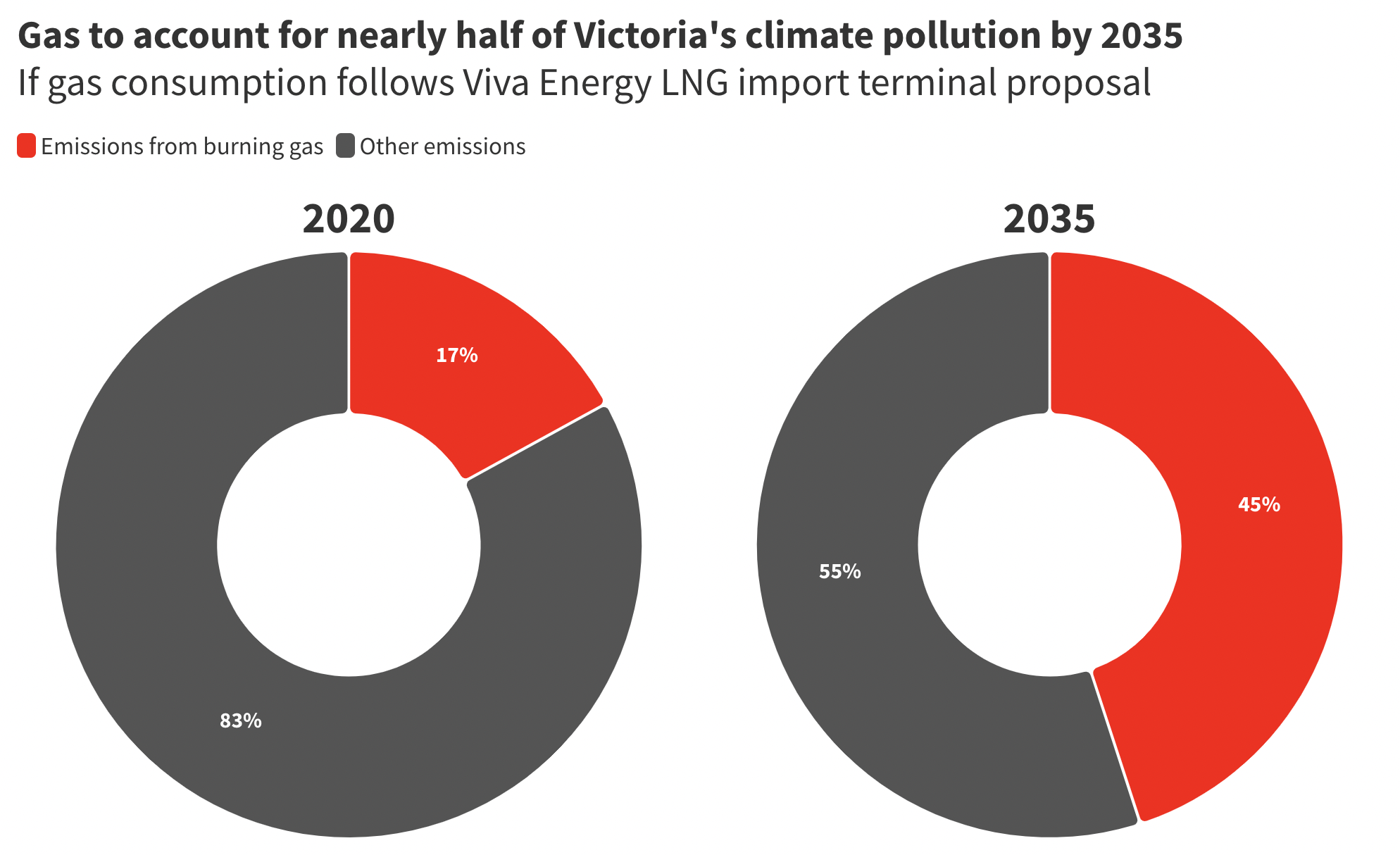
Gas could be biggest source of climate pollution in Victoria by 2035

If the gas industry gets its way, the ‘little blue flame’ could become Victoria’s big pollution problem, accounting for almost half of Victoria’s emissions.