Explaining the Victorian Government's risky wetland engineering scheme.
Drive twenty kilometers down the Murray Valley Highway from Swan Hill and you’ll come to Nyah-Vinifera Park. This is iconic Murray floodplain forest: regent parrots, wetlands and red gums that were here long before colonisers.
Here at Nyah-Vinifera Park the Victorian government is pushing ahead with a risky plan to engineer the floodplain. They want to cut down hundreds of centuries-old River Red Gums to make way for levee banks, concrete, pumps and regulators to artificially manipulate these unique wetlands.
The hidden agenda? To justify reducing water for the Murray River through an ambiguous offset scheme.
To understand what’s happening at Nyah-Vinifera, you have to start with the Murray River itself.
In the early 1900s, the settler government began reshaping the river to suit irrigation and navigation. Weirs were built to create deep, slow pools for paddle steamers and water extraction. Later, massive dams like Hume and Dartmouth turned the Murray into a regulated delivery system for agriculture.
This fundamentally changed how the river behaves.
Before regulation, the Murray followed a natural rhythm:
This seasonal variability created rich ecosystems – supporting fish, frogs and waterbirds across a shifting mosaic of habitats.
Today, that rhythm has been reversed:
The consequences are severe. The river has been reduced to a controlled channel. Floodplains are cut off. Carp thrive in slow, artificial pools. Waterbird populations have declined dramatically – by as much as 90%.
Irrigation channel on the Murray River. Credit: Doug Gimesy
In response to decades of environmental decline, governments introduced water reforms in the 1990s and 2000s, culminating in the Murray-Darling Basin Plan.
The core idea was simple: buy water back from irrigators and return it to rivers and floodplains to restore more natural flows.
But there was a problem. Scientists called for more water than politicians were willing to reclaim from agriculture. So instead of delivering what the river needed, governments created a workaround: an “offset” scheme.
The logic is quintessentially technocratic: red gum forests and wetlands need water to survive. But what if, through levees, pumps and new infrastructure, they could be made to survive on less? The “saved” water could then be retained by multinational agribusinesses, rather than returned to the river.
Nine such projects were proposed across Victoria. Four have been approved, including Nyah and Vinifera – where construction is beginning.
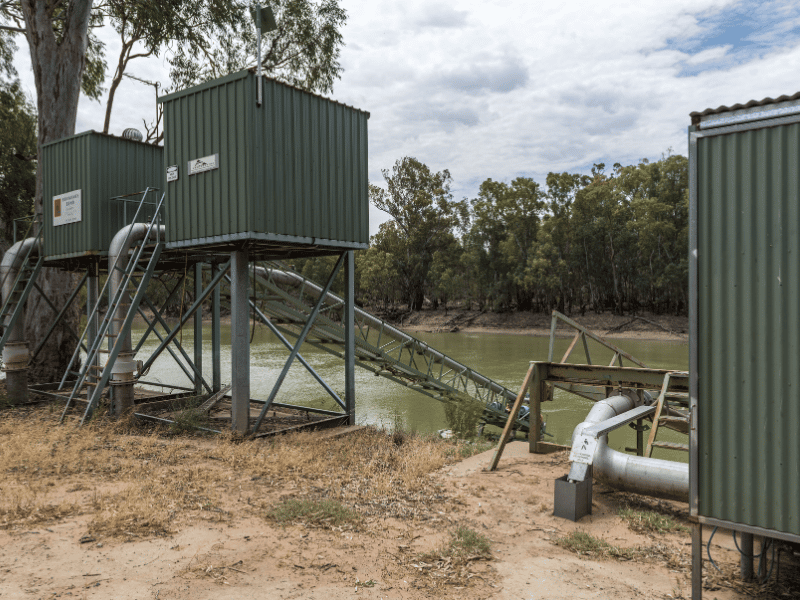
Pumps on Murray at Boundry Bend
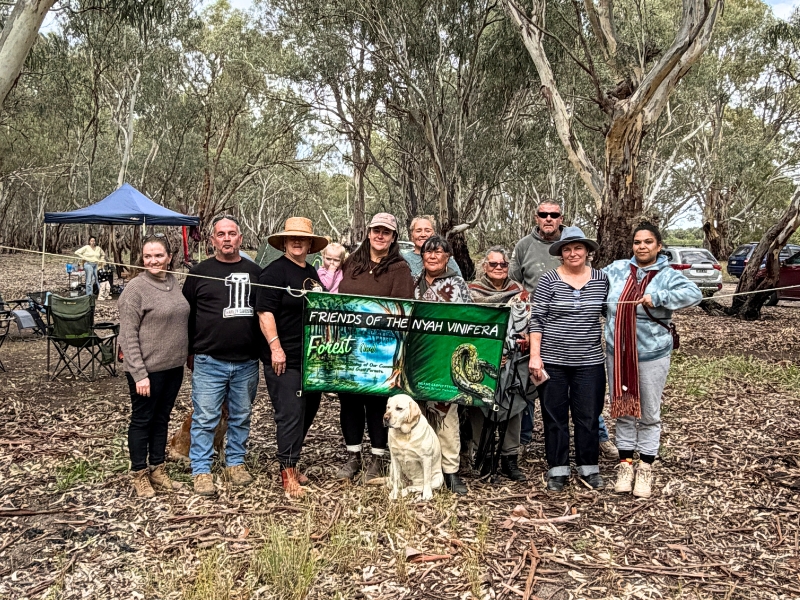
Friends of Nyah-Vinifera Park have been fighting this dodgy wetland engineering plan for years. Alongside Environmental Justice Australia, they challenged the projects in the Federal Court, asking whether the wetlands couldn’t just as well be restored by simply returning flows from the river to the floodplain.
But in May, the court handed down a judgment with typical, procedural logic: decision-makers aren’t required to account for ‘hypothetical’ alternatives. The case was lost and the projects were given the green light.
Friends of Nyah-Vinifera Park and local Wadi Wadi Traditional Owners aren’t giving up though.
“We’re not going to let them come in and cull 300-year-old red gum trees – many with very large hollows that take 160 years to develop – while we have appeals pending,” Jacquie Kelly says.
“There’s a time for different things in a campaign. The time for showing up as a community is here, now. Come and help us. Come and stand at the gates with us. Ring your local Member of Parliament. Ring Murray Watt. Ring Jacinta Allen.”

Alongside Wadi Wadi Elders, Friends of Nyah-Vinifera Park are now camped at the gate of the park in a last-ditch effort to stop bulldozers and machines from moving in.
They’re calling on the community to help protect threatened wildlife habitat, wetlands and centuries-old River Red Gums.