“I am what I am because of the layers surrounding me, the society, the environment, the infrastructure, and my conscience.”
Haritima Bahuguna was born and grew up in the beautiful montane town of Tehri in the central Himalayan state of Uttarakhand in North India, situated at the confluence of the Bhilangana and Bhagirathi rivers.
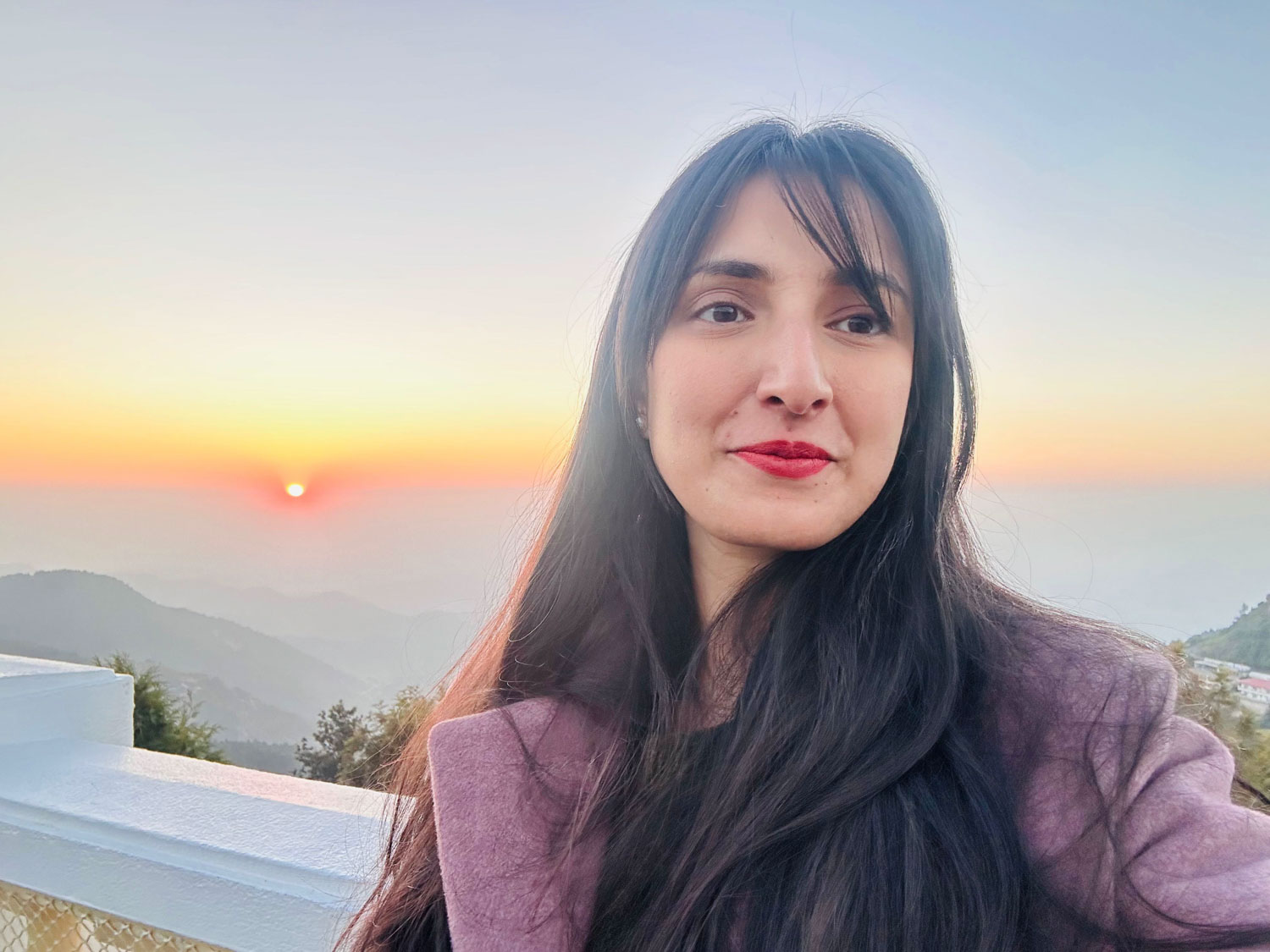
Hari, is currently based in Naarm Melbourne where she works as a policy advisor, but she charts her journey into climate leadership back to her roots and lived experiences.
“I grew up with a strong sense of community, where the township cared for one another and shared a deep relationship with the ecosystem. Caring for neighbours and the ecosystem was not something outside the routine; it was deeply embedded in the lifestyle of the people of Tehri and is still vivid in the region’s cultural festivities.”
Hari’s family were environmental and social activists, and her grandparents led an anti-dam movement in her hometown. The large-scale hydropower dam proposal meant submerging over 30 villages, including Tehri, by blocking the flow of the Bhilangana and Bhagirathi rivers to generate electricity for the state.
“I was too young then to comprehend exactly what was happening, but my memories from Tehri distinctly include Ganga Aarti in the evenings (bowing to and praying in front of the river that blessed us with lives and livelihoods), playing in the open with neighbourhood kids, enjoying treats from neighbourhood aunties, and elders sharing stories of the majestic Himalayas and their brave communities.”
Local families were promised land relocation and financial compensation, but most understood that the dam would destroy their heavenly homeland and fought against the project for over two decades. Despite these efforts, construction of the dam proceeded, and over 100 settlements (villages and small towns) were relocated.
“Today the aftermath of the construction can be seen in the dead ecosystems that once thrived and protected the landscape and its people. The region is now considered one of the most vulnerable to climate change. Over the last two decades we have been witnessing destructive flash floods annually, forcing settlements to leave their homes and move.”
“Development isn’t the evil here,” says Hari, “however, when modern technology allows us to build better, decisions based on improper considerations for the ecosystem and on ticking time and cost can lead to long-term irreversible losses.”
Hari has made it her life mission to educate herself to ensure such bad outcomes are avoided on her watch. After high school, she moved to Tamil Nadu to study Civil Engineering. “At this time, two disastrous flood events hit my home state, Uttarakhand, which had quite an impact on me. Aftermaths of the event made me think that improper planning and incomplete knowledge about the land were the biggest risks to humans and environments, so I started exploring the role of disaster mitigation and urban planning within my degree. This introduced me to the climate crisis and its ineluctable impacts on all systems around us.”
She says she now also better understands how the trickling effect of environmental disadvantage can disproportionately impact communities over the long term in various forms. “The climate crisis is not confined to the environmental domain; it increasingly affects interconnected systems, including food security, infrastructure resilience, and economic stability.”
She became involved in youth climate action towards setting Sustainable Development Goals and the Paris Agreement, which brought her to Naarm in 2019 to pursue a Master’s in Environmental Management at the University of Melbourne, writing a thesis focusing on sub-national implementation of the climate agenda and barriers to its efficient governance.
“I love how much Melbourne has to teach. I love how each Melburnian is so unique—each story provides a fresh perspective—and yet there’s always a common interest that leads to a connection. Adapting to a new city has its own highs and lows, but Naarm’s been kind enough to keep introducing me to wonderful souls who have become a part of my life’s story.”
Having built up her own Australian community, Hari says she makes it a personal priority to take herself out into nature around Melbourne. “Modern systems often emphasise individual tasks, which can subconsciously reduce our physical connection with the natural world. For me, this disconnect sometimes shows up as exhaustion. To counter it, I regularly plan visits to national parks, which ground and inspire me.”
Hari’s life journey has been shaped by both her family and experiences that introduced her to environmental stewardship and social injustice at a young age, and by her own ability to engage with and improve the environment around her for the benefit of broader communities and ecosystems. But she comes back to the human capacity for collective action as her greatest source of hope.
“I see so many people around me caring about the climate crisis and going out of their comfort zones to make a positive contribution. I see youth pushing for their futures, parents for their kids, and elders remembering the landscapes they grew up in. I believe clarity and transparency within systems delivering climate targets can act as a catalyst for efficient resource allocation, which could amplify these efforts.”
“For me, the climate crisis is also an opportunity to reassess, step back from overburdening inefficient systems, and build towards a sustainable future through collective action.”