Explaining the Victorian Government's risky wetland engineering scheme.
11th Jun, 2026
From the blockade at Nyah-Vinifera to the River Peoples' Forum in Swan Hill, communities across the Murray-Darling Basin are challenging a shift towards engineering wetlands instead of restoring river flows.
In June, Friends of Nyah-Vinifera Park hosted the third River Peoples’ Forum in Swan Hill, bringing together First Nations representatives, community members, researchers and water managers. This bi-annual event has become a vital space linking local struggles to Basin-wide water reform.
This year’s focus was on river flows and connectivity.
How do we make sure that water set aside for rivers actually reaches the wetlands and floodplain forests that need it?
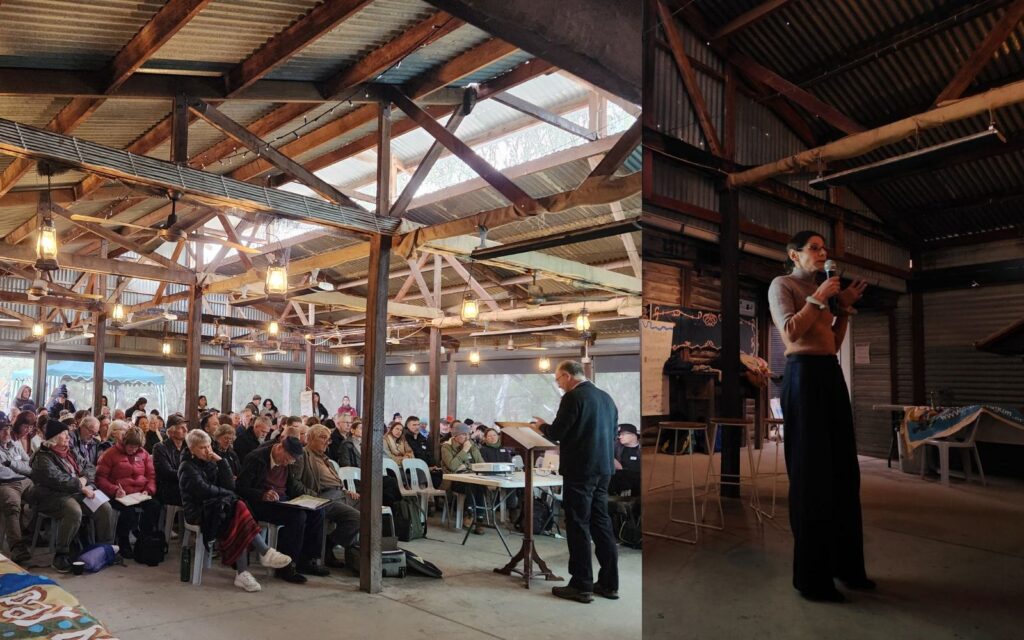
Keynote speakers at the River Peoples’ Forum included ANU Professor Quentin Grafton and Emma Carmody, South Australia’s Commissioner for the River Murray.
When people talk about Murray-Darling water reform, they often focus on the Basin Plan. While it plays a central role in water management today, it’s just one part of a bigger story.
Over the last 150 years, rivers have been reshaped to support irrigation, with increasing volumes of water diverted from rivers and floodplains. Governments first imposed limits on extraction in the 1990s, before the Basin Plan strengthened those protections in 2012. One of its most significant reforms was the creation of a large ‘environmental water’ pool, held by governments for the benefit of rivers, wetlands, fish, frogs, waterbirds and communities.
But environmental water doesn’t automatically flow. Most of it exists as rights, stored in upstream dams until ordered and delivered – sometimes through irrigation infrastructure.
Setting aside water for rivers is one – often highly politicised – task. Equally important is ensuring it reaches the wetlands that depend on it.
Many Basin rivers are flow-stressed, and only 3% of wetlands receive enough water. Quantity is only part of the equation. Timing, connectivity and bottlenecks matter too. Does water flow downstream in ways that reflect natural seasonal rhythms and variability? Are rivers connected to their floodplains? Do wetlands receive the regular inundation they depend on?
These were some of the key questions explored at the River Peoples’ Forum. They’re also fundamental to the blockade at Nyah-Vinifera.
In late May, Wadi Wadi Elders and local community members set up Camp Destruction Disruption – a blockade aimed at stopping the Victorian government’s plan to engineer the Nyah-Vinifera wetlands. The project would see hundreds of centuries-old River Red Gums cut down to make way for levee banks, pumps, concrete structures and steel infrastructure designed to hold water within the wetlands.
The government has framed the project as a last-ditch effort to protect wetlands in an increasingly dry river system. But that framing leaves out a crucial part of the story:
Rather than restoring the flows that once sustained these wetlands, the project represents a shift towards redesigning them to function with less water.
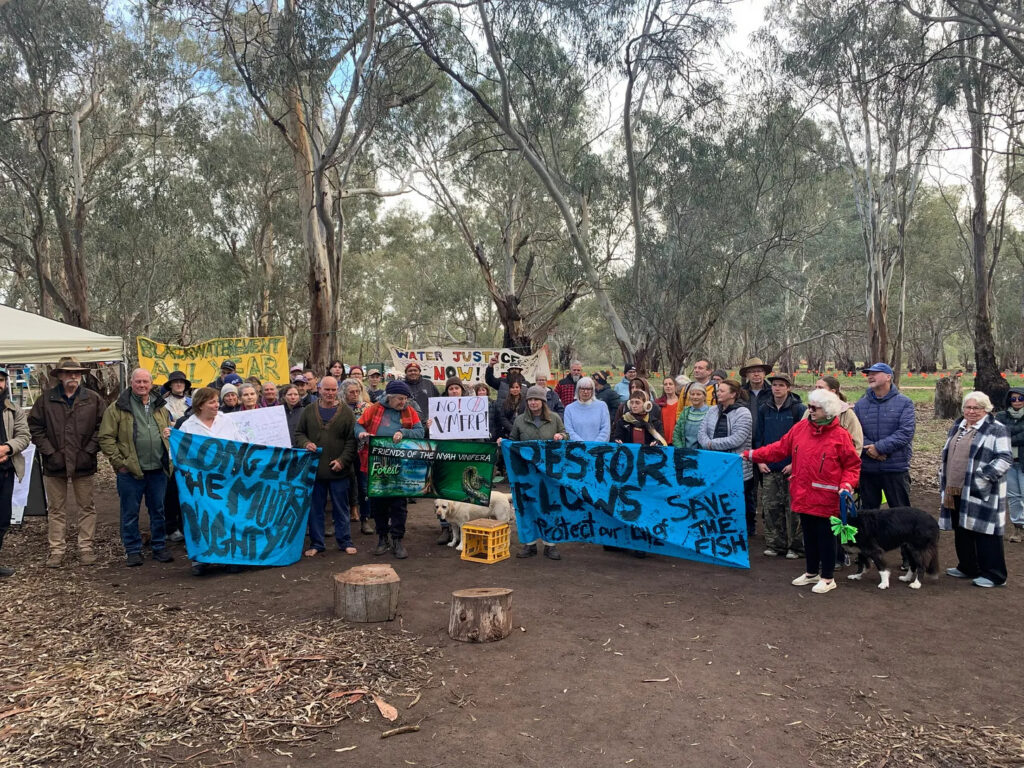
Locals and Environment Victoria supporters gather at the Nyah-Vinifera blockade
Underpinning the project is a technocratic approach to river management: one that prioritises engineering solutions and the efficient operation of water systems. Within this paradigm, rivers become assets to be managed, while Murray cod, River Red Gums and other species are treated as outcomes to be delivered rather than as part of living, interconnected ecosystems.
More troubling, the program emerged from a political assessment, not an ecological one. In effect, it functions as a water offset scheme – perhaps the first in the world. The logic is that if wetlands can be redesigned to need less water, then the savings can be returned to the market. This means the policy can be sold as a way to protect family farms. Politically, it’s a gift to the irrigation lobby. In practice, water will likely be bought by investors – and sold back to desperate farmers each year at prices that erode their margins.
There are reasons to be skeptical. The first is the evident destruction: hundreds of old trees with irreplaceable hollows cleared and subtle floodplain topography modified.
Second, the government has never undertaken a rigorous assessment to determine whether similar outcomes could be achieved through improved river flows.
The third reason is political. The Victorian government presents floodplain engineering as a last resort, necessary because there’s no other way to protect wetlands. Yet at Basin ministerial meetings, Victoria continues to oppose measures that would return more water to rivers, even though those measures could reduce or eliminate the need for engineering projects in the first place.
Then there’s consultation. In July, the Supreme Court found that Victoria had failed to adequately consult Traditional Owners before approving wetland engineering works at Nyah. The government must prepare a new Cultural Heritage Management Plan before proceeding.
The proposal for floodplain engineering lays bare many of the dynamics at play in water governance. The choice between engineering and natural flows, concrete and water, technocratic management and respecting First Nations authority. These questions are pressing – and the simultaneous reviews of the Basin Plan and Water Act provide a rare reform window to address them.
Among the keynote speakers at the River Peoples’ Forum were ANU Professor Quentin Grafton and Emma Carmody, South Australia’s Commissioner for the River Murray. Both stressed the importance of the current opportunity for reform. Too often, commitments have not been fully delivered and existing rules have not been properly enforced, limiting the benefits of water reform. The consequences are becoming increasingly clear. The lower Murray is now recognised as Critically Endangered under federal environment law. Scientists say its survival is essentially a coin toss.
In the audience was a packed room of community leaders, researchers and activists. Among them were a new cohort of River Fellows and a busload of Environment Victoria supporters.
The movement for healthy, connected rivers continues to grow. And there is much to be done.
The opportunity to update the Basin Plan is a rare chance to reset the balance in favour of rivers. But this work isn’t confined to policy processes and ministerial meetings. On the ground, damaging projects like the engineering of the Nyah-Vinifera floodplain still need to be stopped. Necessary programs have stalled, like allowing rivers to flow more naturally. And there are reforms – like returning water rights and decision-making power to Traditional Owners – that the Water Act has barely begun to address.
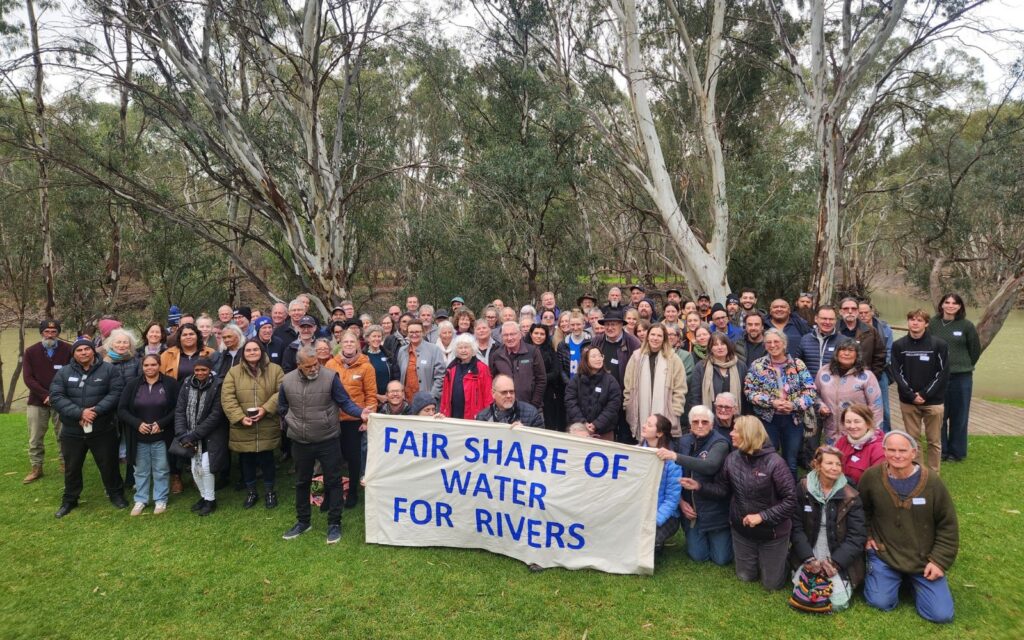
150 people from across the Basin came together for this year’s River Peoples’ Forum